Just before midnight on a Saturday in November, a freight train carrying chlorine, propane, and a dozen other
hazardous chemicals derails in a sleeping suburb west of Toronto. Propane fireballs climb 1,500 metres
into the sky. A punctured tanker leaks 90 tonnes of chlorine — the same gas used as a
weapon in the trenches of the First World War. In the hours that follow, 240,000 people —
98 per cent of the city — are evacuated from their homes in the largest peacetime evacuation
in North American history. Nobody dies.
240,000Evacuated
0Deaths
90 tChlorine on Board
24Cars Derailed
6 daysCity Closed
1979Year
01 · The Train
106 Cars Through the Suburbs
"There's a darkness and a hollow on the highway"Death From Above 1979 — Trainwreck 1979
Canadian Pacific Railway Train No. 54 is a scheduled weekly freight service running east from the chemical plants of Sarnia, Ontario, through Windsor and Chatham, bound for CP's Toronto classification yards. On the evening of 10 November 1979, three locomotives haul 106 cars through the dark at approximately 80 km/h — the posted speed limit for this stretch of track.
The consist is heavy with hazardous cargo. At Chatham, six cars are dropped. At 6:00 PM, 51 additional cars are coupled — these originate from the petrochemical refineries and manufacturing plants of Sarnia, Ontario, colloquially known as "Chemical Valley." Of the final 106 cars, 38 are classified as carrying dangerous commodities by the Canadian Transport Commission. Eleven tankers carry propane or butane. Three carry styrene — roughly 225 tonnes. Three carry toluene. Four carry caustic soda. And one tanker, a heavy-duty DOT 105A500W specification car owned by Dow Chemical of Canada, carries 90 tonnes of liquid chlorine.
Existing regulations permit the marshalling of highly toxic gases directly adjacent to highly explosive liquefied petroleum gases. The chlorine tanker — Car 7 in the wreckage sequence — sits in close proximity to Car 8, loaded with propane. No buffer cars separate them.
Train 54 — Dangerous Goods Manifest
Total cars106
Carrying dangerous goods38
Propane/butane tankers11
Chlorine tanker (liquid Cl₂)1 × 90 t
Styrene tankers3 (~225 t)
Toluene tankers3 (~67 t)
Caustic soda tankers4
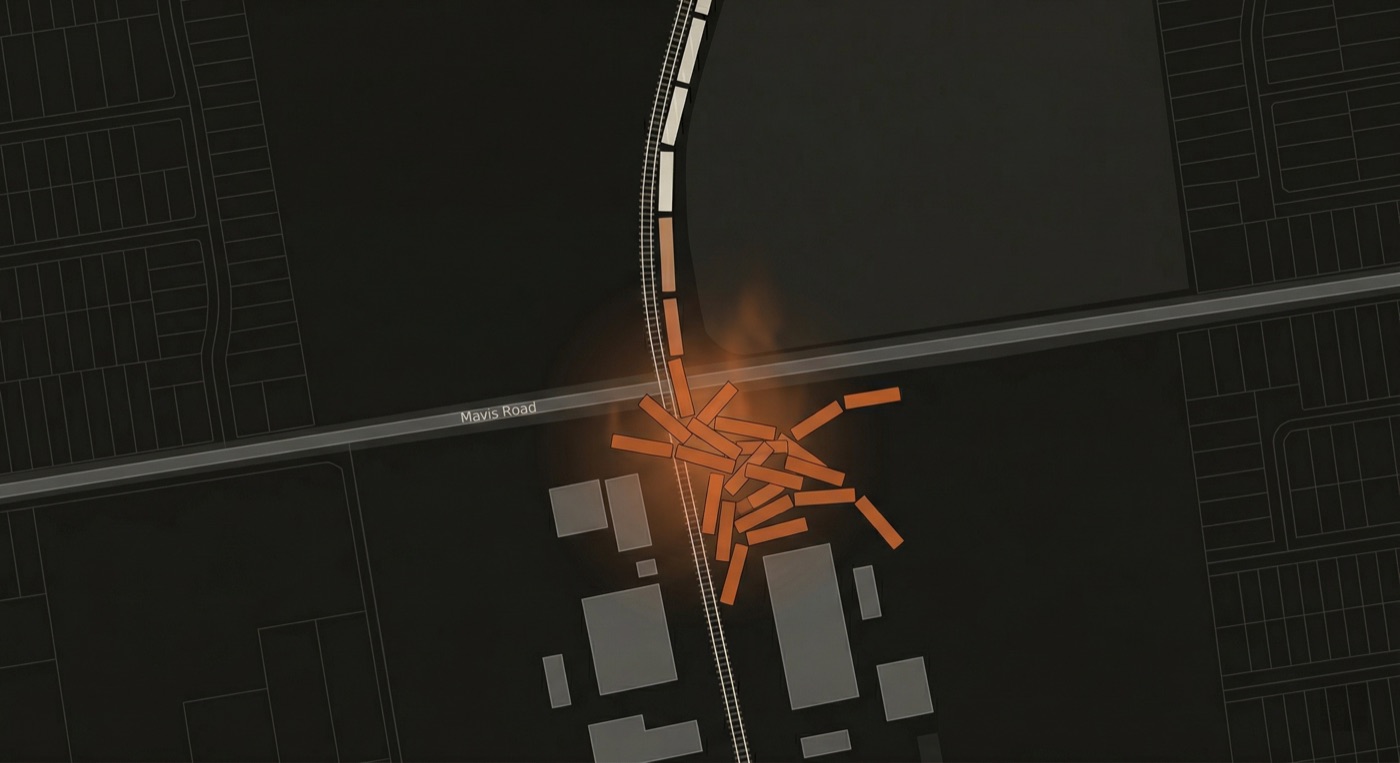
The train's route takes it straight through the heart of Mississauga — a fast-growing city of 284,000 people immediately west of Toronto. In 1979, the rail corridor passes through residential subdivisions, near schools and hospitals, across busy road crossings. Between Derry Road and the derailment site at Mavis Road alone, the track crosses 11 road crossings, passes 5 signals, and threads 8 switches. The tracks predate the suburbs. The suburbs grew up around them.
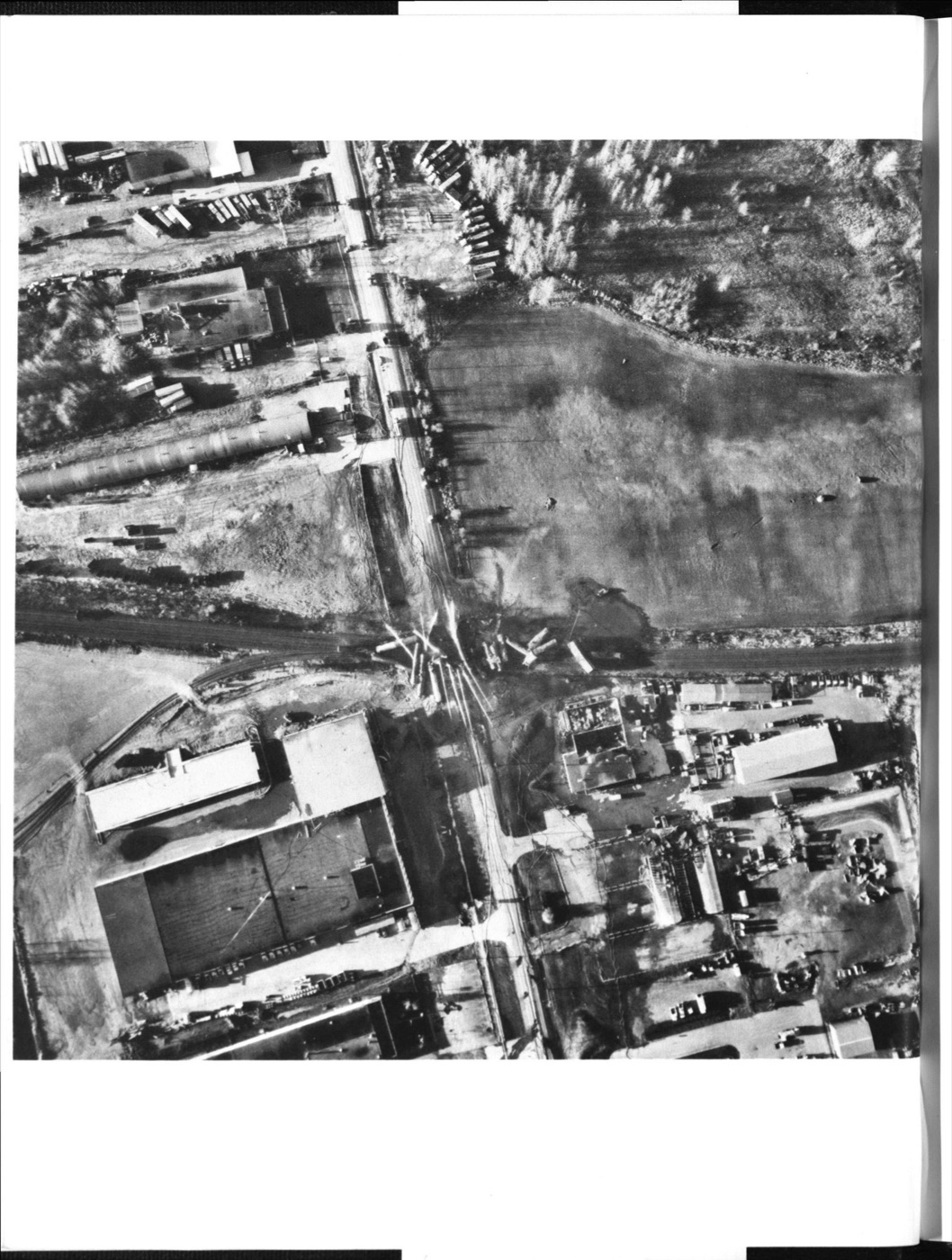
Aerial view of the derailment site at Mavis Road. Industrial property to the south; undeveloped land to the northeast — one of the few open stretches remaining in greater Toronto.Grange Report · Crown Copyright
Derailment site at Mavis Road. Industrial property to the south; undeveloped land to the northeast — "one of the few large areas of undeveloped land remaining in the greater Toronto region" (Grange Report).
"Notwithstanding that the train had entered one of the most concentrated population centres in the country, at the precise point of the derailment, there was to the immediate south only industrial property, and to the north and northeast there existed one of the few large areas of undeveloped land remaining in the greater Toronto region."
— Justice Samuel Grange, Report of the Mississauga Railway Accident Inquiry, 1980
The bearing problem
The 33rd car in the consist — a toluene tanker — rides on journal bearings. These are an older friction-bearing design: a brass or bronze bearing surface that sits directly on the axle, requiring regular manual lubrication with oil-soaked packing. It is a technology essentially unchanged since the nineteenth century.
By 1979, the rail industry is already transitioning to roller bearings — sealed, self-lubricating, and far more reliable. But older rolling stock still runs on the old journal boxes. If the lubrication fails, friction generates enormous heat. The bearing seizes. Railroaders call this a "hot box."
Hot box
A hot box occurs when a journal bearing overheats due to insufficient lubrication, contamination, or mechanical wear. Temperatures can exceed 500°C. Left unchecked, the bearing welds itself to the axle, the axle fractures, and the wheelset separates from the car — causing a derailment. Wayside thermal detectors positioned along rail lines are designed to catch hot boxes before they fail, by measuring infrared heat signatures as trains pass.
02 · The Gaps
Every Cross on the Roadside Tells a Story
"The story never ends as long as we have blood and guts"Death From Above 1979 — Trainwreck 1979
The journal bearing on Car 33 does not fail all at once. It overheats gradually as the train rolls east from Sarnia. The system has multiple opportunities to catch it. Every one of them fails.
Gap 1: Manual inspections
During its 10.5-hour journey, Train 54 is subjected to seven visual running inspections by qualified maintenance employees at various stops and wayside stations. At each, inspectors are supposed to check for signs of overheating — discoloured metal, the acrid smell of burning lubricant, smoke. The journal bearing on Car 33 is not flagged at any of them. Civilian witnesses along the route tell a different story: Mr. and Mrs. McGregor, stopped at the Derry Road crossing, see flames shooting a foot from the undercarriage. Henry Siu, stopped at Eglinton Avenue, sees fire coming from a wheel. The Grange Inquiry will later conclude that the inspections were inadequate.
Gap 2: Wayside detectors
Automated hot box detectors — infrared sensors positioned trackside to measure bearing temperatures as trains pass — are installed along portions of the route. On this night, the detectors that should have caught Car 33's deteriorating bearing either malfunction or are not positioned along the relevant sections of track. The overheating bearing passes through undetected.
Gap 3: Bearing design
The fundamental gap is the bearing itself. Friction bearings require manual lubrication and are inherently prone to failure in a way that sealed roller bearings are not. By 1979, the industry knows this. The transition to roller bearings is underway but incomplete. Car 33 is still running on the old design — a nineteenth-century technology hauling twentieth-century chemistry through a modern city.
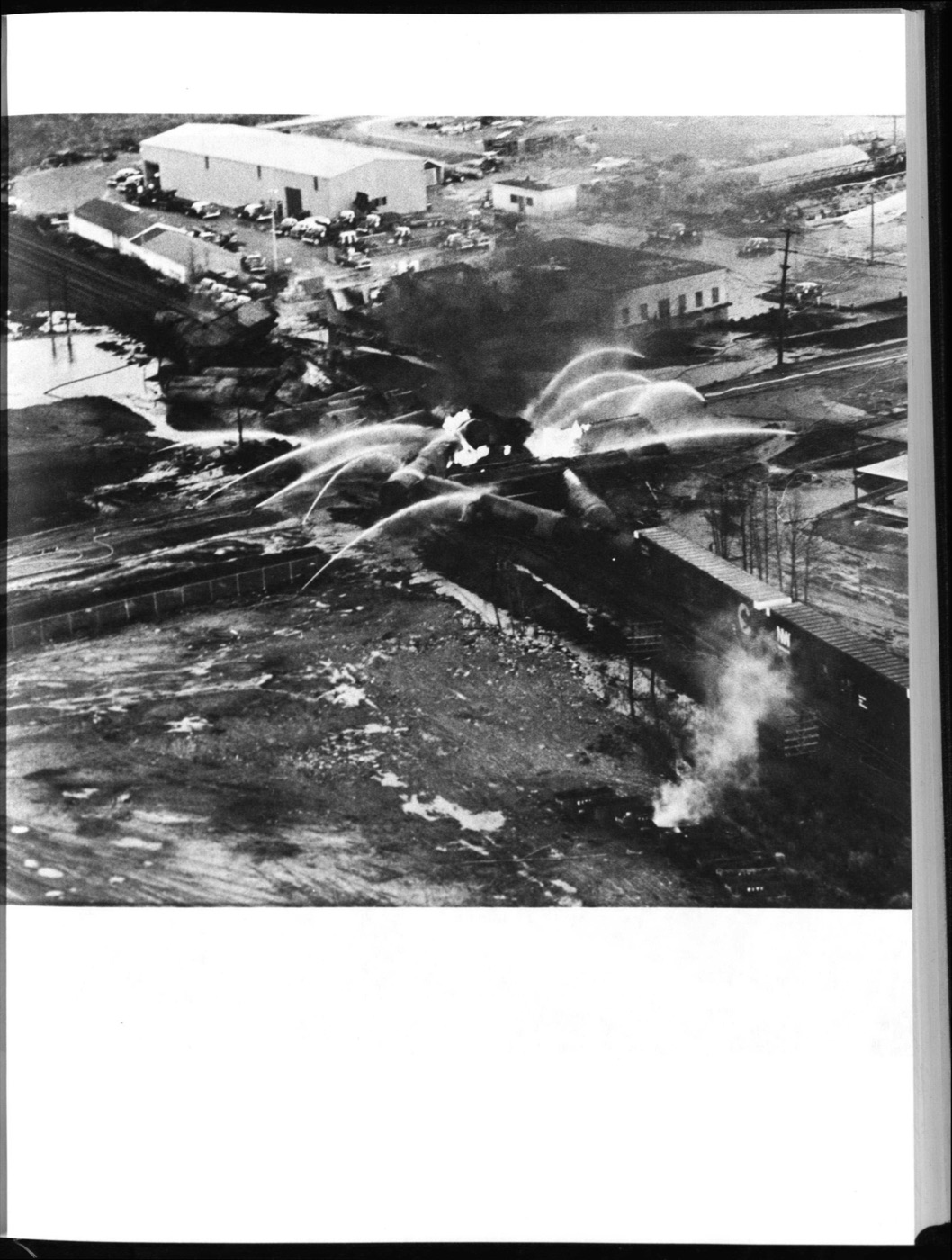
Water streams converge on the burning wreckage from multiple angles. The scale of the firefighting effort — over 100 firefighters within 30 minutes — is visible from the air.Grange Report · Crown Copyright
The Swiss cheese alignment
No single gap caused the Mississauga derailment. An outdated bearing design, missed inspections, and malfunctioning detectors — each was survivable on its own. Combined, they allowed a gradually failing bearing to reach catastrophic fracture while rolling through the most densely populated section of the route. The holes in the Swiss cheese lined up.
"You don't get disasters from one failure. You get disasters from a chain of failures, each one manageable on its own, lining up in exactly the wrong sequence."
— The recurring finding of accident investigation boards worldwide
03 · The People
The Crew, the Mayor, and the Brakeman
The people who will determine whether Mississauga survives this night are already in position — most of them with no idea what is about to happen.
Mayor of Mississauga
Hazel McCallion
Elected just a year earlier, in November 1978. Already nicknamed "Hurricane Hazel" — a reference both to her forceful personality and to the devastating 1954 hurricane that struck Toronto. She is asleep when the phone rings. She will not sleep again for three days.
Head-End Brakeman, CP Rail
Larry Krupa
Twenty-four years old. Working alongside his father-in-law, engineer Keith Pruss. When the train derails, Krupa will run toward the fire to uncouple tanker cars from the burning wreckage — an act investigators later describe as "bordering on lunacy."
Engineer, CP Rail
Keith Pruss
Train 54's engineer. Once Krupa uncouples the surviving cars, it is Pruss who pulls them two kilometres down the track to safety. His son-in-law's life is in the fire behind him.
Chief of Police, Peel Regional
Douglas Burrows
Alerted at 00:19 on 11 November. Picks up his deputy, Bill Teggart, en route to the scene. Within two hours he will order the largest evacuation in Canadian history — a decision made with incomplete information, in the dark, with propane exploding behind him.
Fire Chief, Mississauga
Gordon Bentley
Coordinates the on-site fire response. Within thirty minutes of the derailment, he has over 100 firefighters on scene with eight pumpers, three ladder trucks, and two rescue vehicles. He will log 186 hours on duty over the next ten days.
Conductor, CP Rail
Ed Nichol
Stationed in the caboose at the rear of the 106-car consist. When the derailment throws him from his seat and leaves him badly bruised, Nichol recovers the train's cargo manifest from the caboose and delivers it directly to the first arriving firefighters — providing the first concrete evidence that chlorine is among the burning cargo.
04 · The Derailment
It Ran Off the Track
"It ran off the track, eleven seventy-nine"Death From Above 1979 — Trainwreck 1979
At approximately 23:53 on Saturday 10 November 1979, as Train 54 crosses Burnhamthorpe Road, the journal bearing on Car 33 finally gives way. The temperature has long since exceeded 500°C. The bearing welds to the axle. The axle fractures. The wheelset separates.
The detached wheels and axle crash through a residential fence and land in the Riddels' backyard near Burnhamthorpe. But the crippled car does not stop. It continues on its remaining six wheels — four on the rails, two off — dragging its rear truck sides along the ties, shedding journal box steel, brake shoes, bearings, and lubricator pads at every crossing. It rides like this for over a mile. At Erindale Station Road, the front wheels of the trailing truck derail. Still the car keeps moving. Finally, at approximately 23:56, the whole rear truck catches on a switch near the Alkaril Chemical building just west of Mavis Road. The car derails. The twenty-three cars behind it pile up in a chain reaction of buckling steel and ruptured tankers.
Twenty-four cars leave the track. Twenty-one are tank cars. Nineteen are carrying dangerous goods.
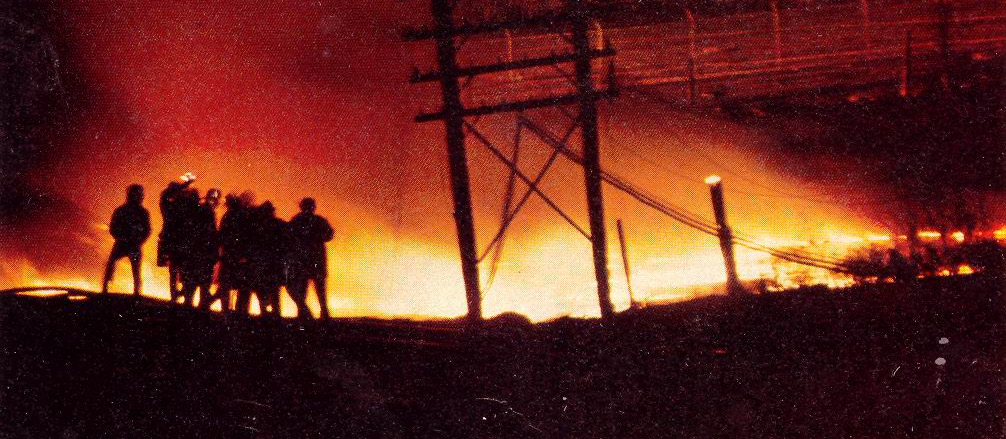
Firefighters silhouetted against the propane fires, which burned for approximately 50 hours.Toronto Sun · Heritage Mississauga
23:53 EST
Bearing fails at Burnhamthorpe
The axle fractures. The wheelset separates and crashes into a residential backyard. The crippled car rides on six wheels, dragging wreckage along the track bed for over a mile.
~23:56
Derailment at Mavis Road — ignition
Car 33 catches on a switch at Mavis Road. Twenty-four cars pile up. Ruptured propane tankers ignite almost immediately. At 23:56:27, engineer Pruss radios dispatch: "into emergency — the big hole." Brakeman Krupa, looking out the rear cab window, shouts to his father-in-law: "Oh, my God, we've got a tanker afire!" A fireball climbs approximately 1,500 metres into the night sky. The flash is visible 100 kilometres away in downtown Toronto, and as far as Niagara Falls.
~23:57
First BLEVE — Car 8 explodes
Exactly twenty seconds after Pruss's emergency call, Car 8 — loaded with propane — undergoes a catastrophic Boiling Liquid Expanding Vapour Explosion. The Grange Inquiry will later document the trajectories precisely: the body of Car 8 is hurled 145 feet east. Cars 12 and 13 follow within the next half hour — Car 12 flies 440 feet southeast, and Car 13 is flung 2,222 feet — more than 675 metres — to the northeast. The concussion knocks police officers and firefighters into ditches.
~23:58
Krupa runs toward the fire
Brakeman Larry Krupa sprints back along the train toward the derailment. He reaches the coupling between the burning wreckage and the intact cars still on the rails, shuts down the air brakes on an undamaged car, and uncouples it. Engineer Pruss pulls the surviving cars two kilometres down the track to safety.
00:04, 11 Nov
Firefighters arrive
Local firefighters reach the scene. Within thirty minutes, Chief Bentley will have over 100 firefighters deployed with eight pumpers, three ladder trucks, and two rescue vehicles.
00:19
Police Chief alerted
Chief Douglas Burrows is called at home. He picks up Deputy Chief Bill Teggart en route to the scene. They can see the orange glow in the sky from kilometres away.
~01:30
First evacuation order
Burrows orders the evacuation of approximately 3,500 residents within 900 metres of the derailment site. Police vehicles with loudspeakers drive through darkened streets. Officers go door to door.
~04:00
Third major explosion
Another propane BLEVE triggers a further expansion of the evacuation zone. The fires are intensifying, not dying down.
06:00
Chlorine confirmed leaking
As daylight arrives, firefighters confirm what they have feared: the chlorine tanker has been punctured. A hole two and a half feet in diameter is visible in the tanker's shell. Chlorine gas is leaking at roughly 35 pounds per hour. The evacuation zone expands dramatically.
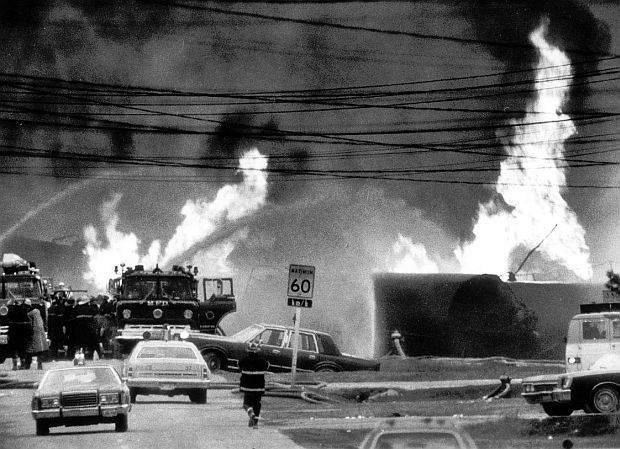
Multiple fires burn simultaneously as emergency vehicles crowd Mavis Road. The 60 km/h speed sign stands in mute contrast to the inferno behind it.Pop History Dig
BLEVE — Boiling Liquid Expanding Vapour Explosion
When a pressurised liquid container is heated by an external fire, the liquid inside boils. Vapour pressure climbs until it exceeds the container's structural capacity. The container ruptures catastrophically, releasing expanding vapour that ignites in a massive fireball. The container itself becomes shrapnel. A propane BLEVE can hurl a tank car hundreds of metres and generate temperatures exceeding 1,300°C at the centre of the fireball.
"I was surprised we weren't killed. When it blew up and I saw that flash, I thought, 'Well, this is it.' But then everybody got up and nobody was hurt."
— Chief Fire Inspector Cyril Hare, whose own home caught fire from the derailment
05 · The Chlorine
A Poison Cloud, a Flaming Sky
"A poison cloud, a flamin' sky"Death From Above 1979 — Trainwreck 1979
The propane fires are spectacular and terrifying. But it is the chlorine that keeps emergency officials awake for six days.
In the first hours, confusion reigns over what the train is actually carrying. Ed Nichol's manifest, recovered from the caboose, is difficult to read in the dark and smoke. An early rumour circulates that the train carries toxic PCBs — it does not. An updated manifest relayed from the CP dispatch office in Toronto eventually confirms the true cargo. The confirmation of chlorine is worse than PCBs.
Chlorine is a pale green-yellow gas, 2.5 times heavier than air. It sinks. It pools in basements, in ditches, in low-lying ground. At 30 parts per million it causes chest pain and coughing. At 400 ppm, it is lethal within thirty minutes. At 1,000 ppm, it kills within minutes. In the First World War, chlorine and its derivative phosgene were the primary killing agents of gas warfare — responsible for approximately 85,000 deaths.
The tanker on Train 54 carries 90 tonnes of it.
Chlorine — Exposure Thresholds
Odour threshold (sharp, bleach-like)0.5 ppm
Workplace limit (8-hour TWA)1 ppm
Chest pain, coughing30 ppm
Lethal within 30 minutes400 ppm
Lethal within minutes1,000 ppm
Peak reading at derailment site15 ppm
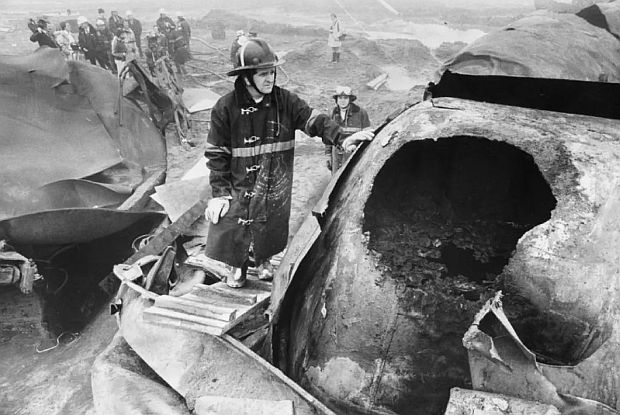
A firefighter examines the hole torn in the chlorine tanker — two and a half feet in diameter, large enough to climb through. Ninety tonnes of liquid chlorine were inside.Toronto Star · Pop History Dig
The lucky break
The derailment punctures the chlorine tanker, tearing a hole two and a half feet in diameter — large enough for a person to climb through. The safety relief valve fails to activate, and as the external fires heat the tank, a corrosive reaction between the liquid chlorine and the overheating steel shell accelerates the breach.
How much chlorine escapes is impossible to determine precisely — even the Grange Inquiry cannot establish an exact figure. What Justice Grange does establish is this: the BLEVEs of the propane cars "sucked up much of the Chlorine out of the tank and lifted it into the sky where it was dissipated more or less harmlessly." When Stu Greenwood of the Dow Chemical CHLOREP team manages to measure the remaining level on Monday — peering into a tank 102 inches deep — he finds two to three feet of liquid and ice remaining. He estimates roughly 20 tonnes are still inside. The rest — the majority of the 90-tonne payload — is gone. Under normal circumstances, this release would be catastrophic: a dense, lethal cloud rolling through suburban streets at ground level.
But the propane fires save Mississauga.
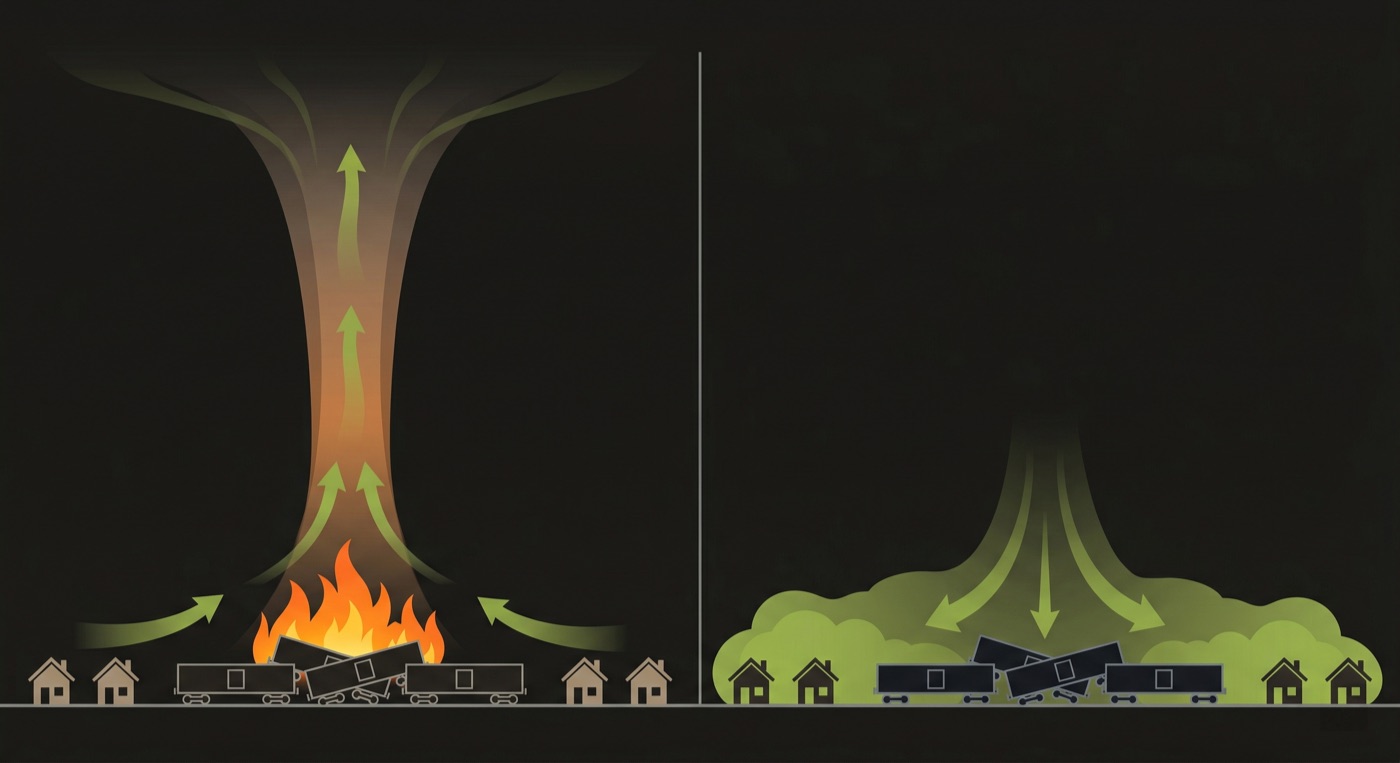
The massive fireballs draw the escaping chlorine gas upward. The heat column from the burning propane acts as a chimney, pulling the chlorine high into the atmosphere where it disperses over Lake Ontario rather than settling into streets and basements. The very thing that made the disaster look apocalyptic — the towering fireballs visible from Niagara Falls — is also the thing that prevents a mass poisoning. A subsequent review by The Economist estimated that the amount of chlorine present was sufficient to kill 24,000 people given the population density of the surrounding area.
Left: with fire — the thermal updraft draws chlorine upward and disperses it at altitude. Right: without fire — chlorine, 2.5 times heavier than air, sinks to ground level and pools around residential areas.
Fire Chief Gordon Bentley and Etobicoke Fire Chief Bryan Mitchell recognise this dynamic — and make a counter-intuitive decision that may be the most important tactical call of the entire crisis. Rather than attempting to extinguish the propane fires, they implement a controlled burn strategy. Firefighters retreat to a safe distance and deploy ten master streams through over 4,000 metres of hose — not to put the fires out, but to cool the surrounding unexploded tank cars and let the propane burn off safely. Extinguishing the fires would collapse the thermal updraft. The chlorine would pool at ground level. The fires must keep burning.
The controlled burn takes 50 hours. The fires are finally declared out at dawn on Tuesday, 13 November.
The Youngstown precedent
The threat was not theoretical. The Grange Report documents the precedent directly: on 26 February 1978, a train derailment in Youngstown, Florida ruptured a chlorine tank car. There was no secondary fire to create an updraft. "About 50 tons of Chlorine was lost in the first few minutes. There was very little wind and the cloud drifted to a nearby highway killing 8 motorists and their passengers. Some 89 persons were hospitalized and hundreds affected." Stu Greenwood of Dow Chemical had attended that response personally. At the Mississauga command post, he knew exactly what chlorine did when it stayed at ground level.
Sealing the tanker
Greenwood's initial estimate of 20 tonnes is later revised downward. The ice layer — chlorine hydrate, formed when firefighting water entered the tank — is 6 to 12 inches thick, masking the true liquid level. Command post documents settle on "about 10 tons of liquid Chlorine." It continues leaking at roughly 35 pounds per hour by vapourisation. The leak cannot be sealed while propane fires still burn nearby.
Dow Chemical's CHLOREP team, which departed Sarnia at 03:30 and arrived at the scene by 06:30, cannot even locate the chlorine car on the first day because of the intensity of the fire. Procor, a railcar manufacturer, fabricates a steel patch. On Tuesday, after the fires die down, the patch is applied. By Wednesday, Greenwood tells the command post they have a "controlled situation" — but he cannot guarantee that something might not happen to the ice layer which might cause a sudden release of gas.
On Thursday, vacuuming begins. The Grange Inquiry records that an estimated 7.5 tonnes of chlorine are extracted between Thursday and the following Monday, much of it neutralised with caustic soda during the vacuuming process itself. The figures of weight transferred to trucks are unreliable because the neutralisation converts the chlorine before it can be weighed.
By Friday 16 November, the evacuation order for the inner zone is finally lifted. Mississauga can breathe again.
06 · The Evacuation
While the Immigrants Slept
"While the immigrants slept, there wasn't much time / The mayor came callin' and got 'em out of bed"Death From Above 1979 — Trainwreck 1979
This is a pre-mobile-phone world. It is the middle of the night. Most of Mississauga is asleep. And in the hours after the derailment, the authorities must wake a quarter of a million people and move them — calmly, safely, and fast.
"Our house shook. The windows rattled. The sky was bright orange, and when I saw the fireball, we were already running to the car, only with the clothes we had on, and on our way out of the city. We didn't even know where we were going."
— Mississauga resident
Approximately 500 police officers are on duty at any given time. They drive through residential streets with loudspeakers and bullhorns, then go door to door, marking driveways with an "X" to signify a home has been emptied. Local radio and TV stations — CFRB, CHUM, CBC, and a dozen others — go to round-the-clock coverage, becoming the primary emergency broadcast system. Police process over 50,000 telephone enquiries from the public during the crisis.
The decision
At 07:30 on Sunday 11 November, a decision-making committee forms: Police Chief Doug Burrows, Fire Chief Gordon Bentley, Regional Chair of Peel Frank Bean, and Mayor Hazel McCallion. They are later joined by Ontario Solicitor General Roy McMurtry and Deputy Minister John Hilton.
Hurricane Hazel takes command
McCallion makes a strategic decision that will define the crisis. She defers all tactical operations — firefighting, perimeter control, hazmat response — to the police and fire chiefs. Instead, she assumes total control of public communication, inter-governmental liaison, and civic administration. She formally invokes emergency powers and makes an unprecedented declaration: Mississauga is "closed until further notice."
Early in the crisis, she severely sprains her ankle at an evacuation centre, but refuses medical leave. OPP Deputy Commissioner Jim Erskine physically carries her into press conferences. She holds continuous, transparent briefings — projecting stability and absolute authority at a moment when a quarter-million people need to know someone is in charge. Solicitor General McMurtry, recognising her effectiveness, largely defers to the mayor, avoiding the jurisdictional infighting that cripples so many disaster responses.
"If this had happened a half mile farther down the track, either east or west, we would have seen thousands of people wiped out. It's a miracle it happened here."
— Mayor Hazel McCallion
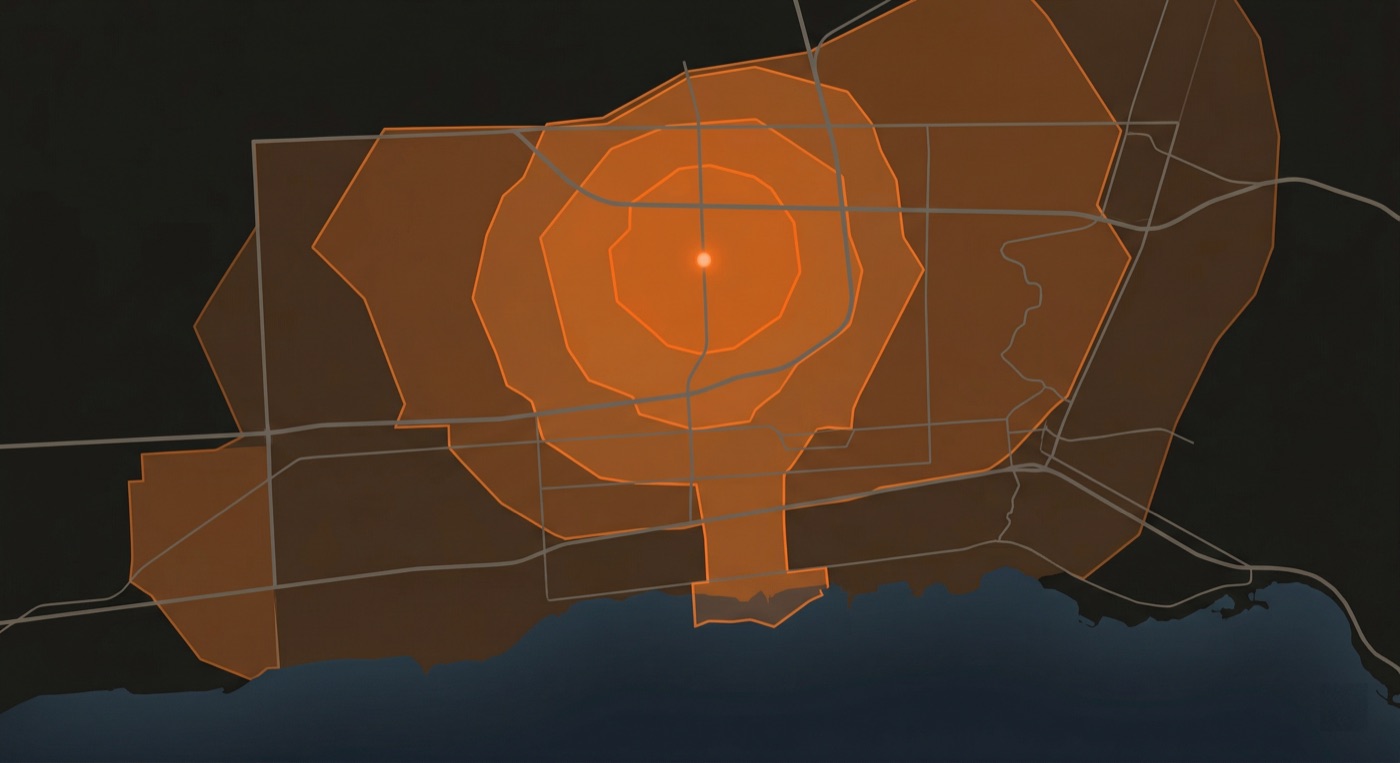
The committee makes thirteen boundary adjustments over the next two days as wind direction — tracked continuously by Environment Canada meteorologists — chlorine readings, and fire conditions change. The evacuation zone expands steadily — first south to Lake Ontario, then east and west. By Sunday evening it includes parts of neighbouring Oakville. At its peak, the zone covers approximately 96 square kilometres.
~01:30 Sunday
Initial zone — 900m radius
3,500 residents evacuated. Police vehicles with loudspeakers. Door-to-door checks in the dark.
~04:00
Zone expands after third explosion
Evacuation boundary pushed outward. More neighbourhoods are woken.
06:00
Chlorine leak confirmed
The discovery of the punctured chlorine tanker transforms the evacuation from a fire precaution into a chemical emergency. The zone expands dramatically.
13:30 Sunday
South to Lake Ontario
Evacuation extends to the lake shore. The wind could push chlorine in any direction.
Sunday evening
Peak evacuation — 240,000+
The zone now encompasses most of Mississauga and parts of Oakville. An estimated 98 per cent of the city's population has left their homes — more than 240,000 people (sources vary between 218,000 and 250,000 depending on the count). It is the largest peacetime evacuation in North American history.
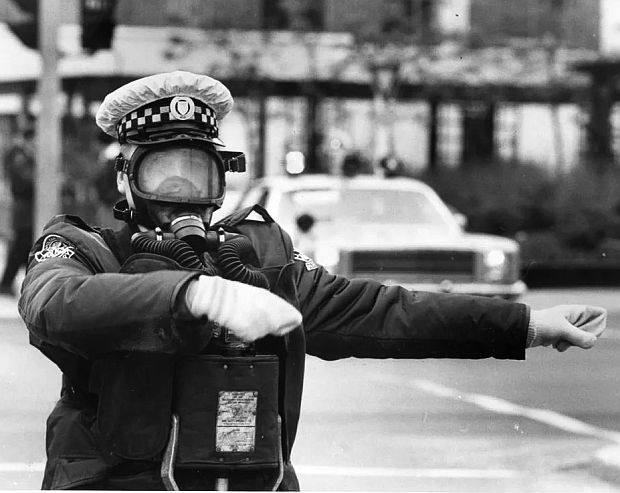
The expanding evacuation zones. Thirteen boundary adjustments over two days, radiating outward from the Mavis Road derailment. At its peak, the zone covered 96 square kilometres — 98% of the city's population.An auxiliary policeman directs traffic in a gas mask at Highways 10 and 5 — the chlorine threat made ordinary policing surreal.Toronto Star · Pop History Dig
The logistics
Three hospitals are cleared: Mississauga General, Oakville-Trafalgar Memorial, and Queensway. Six nursing homes are emptied. Over 2,000 patients are moved using 159 ambulances drawn from 25 regional services. The hospital clearances take eight hours.
Nineteen facilities serve as reception centres. Mayor McCallion opens Square One Shopping Centre — just 2.5 kilometres from the derailment site — as the primary shelter. Many evacuees arrive in nightclothes. The Canadian Red Cross, St. John's Ambulance, the Salvation Army, and the Mississauga and Ontario Humane Societies all deploy. Tens of thousands of people pass through the centres over the six-day crisis — though most evacuees stay with friends and family rather than in shelters. The Red Cross alone serves over 36,000 meals to evacuees and a similar number to emergency personnel. Local businesses provide free food and supplies.
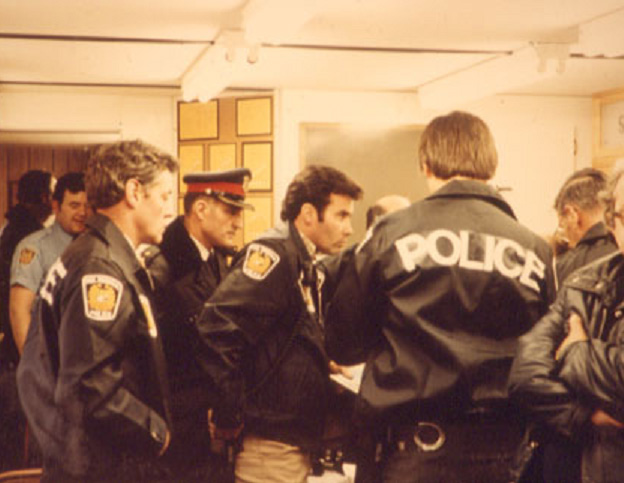
The police command centre. Peel Regional Police coordinated the evacuation of 240,000 people from this room, making 13 boundary adjustments as conditions changed.Mississauga Library System · Heritage Mississauga
The logistics of moving a quarter-million people work partly because of timing and demographics. Mississauga in 1979 is an affluent, heavily motorised suburban sprawl — nearly every household has at least one car. The disaster falls late on a Saturday night heading into the Remembrance Day long weekend: commuter traffic is non-existent, families are together at home, commercial activity is paused. Post-event studies reveal that over 85 per cent of households self-evacuate in their own vehicles. Approximately 85 per cent of evacuees go to the homes of friends and family in Toronto, Hamilton, and surrounding regions. The phased nature of the evacuation acts as a natural metering system, preventing gridlock on the QEW and Highway 401.
There is no panic. People pack what they can and go. Families are separated with no easy way to find each other — this is 1979, and mobile phones are decades away.
Zero looting
Police patrol the empty streets of a city of 284,000 for nearly a week, running nightly helicopter patrols with floodlights. Criminal activity is virtually non-existent. The people of Mississauga simply leave, trust that their homes will be safe, and come back when they are told it is safe to do so.
"I went to bed in Mississauga and woke up in Oakville."
— Matthew Wilkinson, Heritage Mississauga historian, evacuated as a child
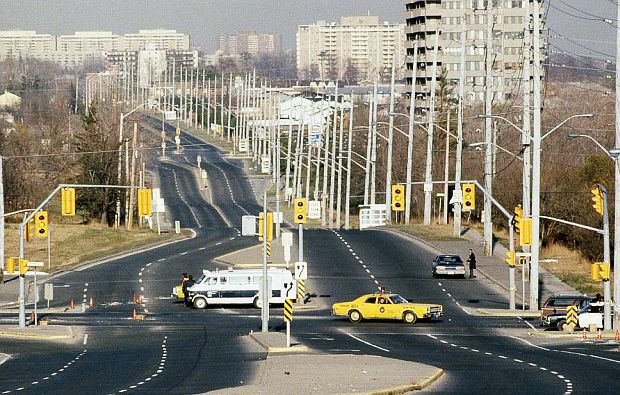
A city of 284,000 people, empty. Police roadblocks seal the evacuation zone while apartment towers stand silent in the distance.Pop History Dig
Firefighters enter evacuated homes to feed pets after residents drop house keys at City Hall. No animals die. Children later remember the evacuation as a "fun adventure" — waking up somewhere unfamiliar, sleeping on gymnasium floors, the excitement of disrupted routine. The adults remember the fear.
The return
On 13 November, after the propane fires are finally extinguished following roughly 50 hours of burning, air sampling confirms safety in the outer zones. 144,000 residents are allowed home. On 16 November, after the chlorine is pumped out, 37,000 more return. At 19:45 that evening — nearly six full days after the derailment — the last roadblocks come down. The city reopens.
07 · The Margins
There's No Hero, There's No Villain
"There's no hero; there's no villain / There's nobody I can blame"Death From Above 1979 — Trainwreck 1979
The Mississauga Miracle earned its name. But the margins between miracle and catastrophe were razor-thin. Change any one of several variables and the story ends very differently.
What if the chlorine had stayed at ground level?
The majority of the 90-tonne chlorine payload escaped into the atmosphere. The propane BLEVEs "sucked up much of the Chlorine out of the tank and lifted it into the sky," according to Justice Grange. The Economist estimated there was enough chlorine present to kill 24,000 people. If there had been no propane fire — or if the chlorine had leaked after the fires died down and the thermal updraft collapsed — a dense, invisible cloud of gas 2.5 times heavier than air would have rolled through residential streets, pooling in basements and low-lying areas. At lethal concentrations, it destroys lung tissue within minutes. At Youngstown, Florida, just 20 months earlier, 50 tonnes of chlorine released without a fire updraft killed 8 people and hospitalised 89.
What if the derailment had happened 20 miles further east?
Train 54 was bound for Toronto. If the bearing had held for another half hour — 20 miles further along the route — the derailment would have occurred in the densely populated core of metropolitan Toronto. The evacuation of 240,000 people from a suburban city with wide roads and clear escape routes was extraordinary. Evacuating downtown Toronto in the middle of the night, with its narrow streets, high-rise apartments, and a population in the millions, would have been a different order of magnitude entirely.
What if the wind had shifted?
The decision-making committee tracked wind direction as the single most critical variable throughout the crisis. If the wind had blown the chlorine cloud inland over the populated residential areas east of the derailment — rather than conditions allowing upward dispersal — the evacuation might not have been fast enough. Wind direction was the one factor nobody could control.
What if Larry Krupa hadn't uncoupled the cars?
When the train derailed, 24 cars left the track — but the remaining 82 cars, many still carrying hazardous cargo, were still coupled to the wreckage. Krupa ran toward the fire, disconnected the coupling, and allowed engineer Pruss to pull them to safety. Pruss later estimated that "if he hadn't done that, more than half of Mississauga would have gone up."
What if it had been a weekday?
The derailment occurred late on a Saturday night, when most residents were at home asleep. On a weekday, tens of thousands of people would have been scattered across offices, schools, and transit — making a coordinated evacuation far more difficult. The timing, by chance, placed most residents in the one place where they could be reached by door-to-door police teams.
"If he hadn't done that, more than half of Mississauga would have gone up."
— Engineer Keith Pruss, on Larry Krupa's decision to uncouple the cars
08 · Aftermath
Two Hundred Thousand People and No One Died
"And all before the pocket dial"Death From Above 1979 — Trainwreck 1979
On 4 December 1979 — less than a month after the derailment — the federal government orders a public inquiry by Order-in-Council. Justice Samuel Grange of the Supreme Court of Ontario is appointed commissioner. The inquiry occupies 127 days of evidence and argument. There are 687 exhibits, many of them multiple documents, and 23,594 pages of transcript. The resulting report, released in December 1980, makes 15 recommendations that will reshape Canadian rail safety.
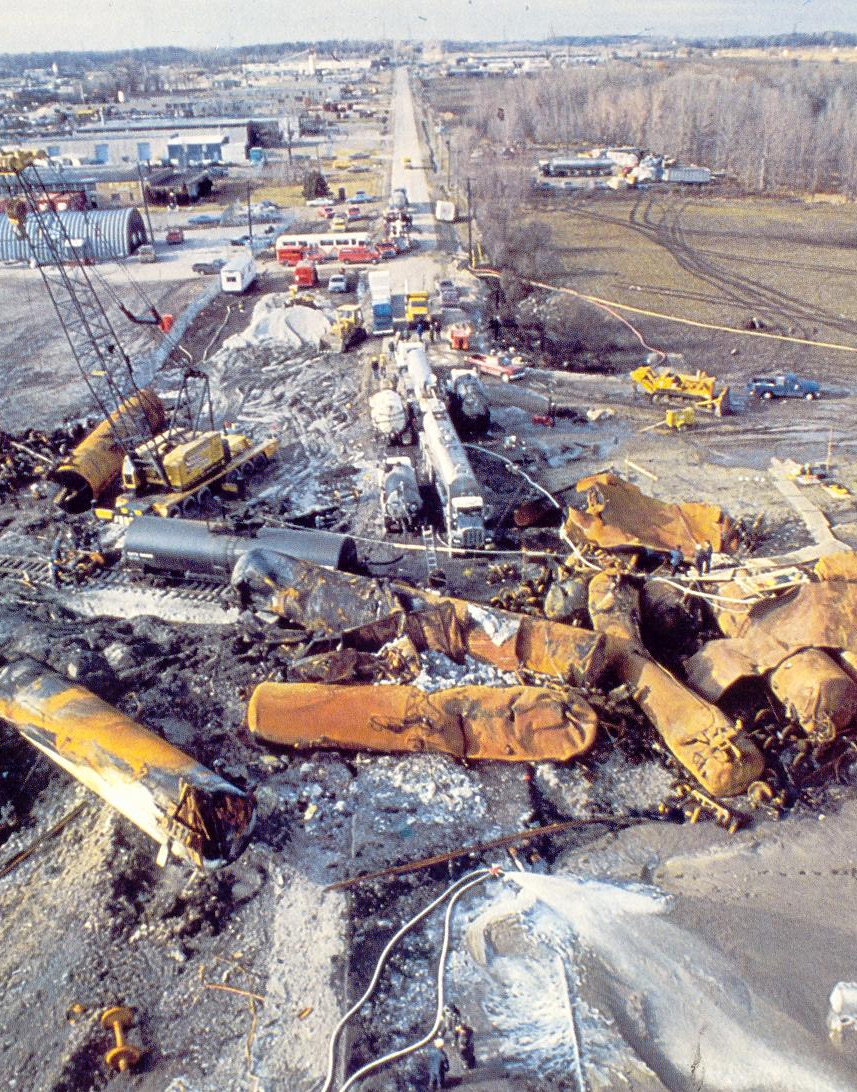
The aftermath at Mavis Road, looking north. Twisted tanker cars — their orange and yellow paint scorched — lie scattered across the derailment site during cleanup operations.City of Mississauga · Heritage Mississauga
The findings
The primary cause is straightforward: the failure of a journal bearing on Car 33 due to inadequate lubrication. But the inquiry goes further, identifying the systemic gaps that allowed a predictable mechanical failure to escalate into the largest evacuation in North American history.
The hot box was missed at three inspection points. Wayside thermal detectors along the route had malfunctioned. The older friction-bearing journal boxes were a known systemic risk, and the transition to roller bearings had been too slow.
The changes
The Grange Inquiry's recommendations drive swift and far-reaching reform:
Key Regulatory Changes
Transportation of Dangerous Goods Act1 Nov 1980
Mandatory roller bearings (all cars)By 1987
Speed limit in populated areas35 mph (56 km/h)
Hot box detectors on hazmat routesMandatory
Emergency Response Assistance PlansRequired
The Transportation of Dangerous Goods Act comes into force on 1 November 1980 — less than a year after the derailment. It establishes comprehensive federal regulation of hazardous materials transport in Canada: proper labelling, documentation, containment standards, and emergency response planning. The act remains the foundation of Canadian dangerous goods regulation today.
Roller bearings become mandatory on all rail cars by 1987, ending the era of the friction journal box. Hot box detectors become required along all routes carrying hazardous materials through populated areas. Speed limits are reduced. Pre-entry inspections are mandated for trains approaching cities with populations over 10,000.
The Mississauga derailment also catalyses the Canadian chemical industry's "Responsible Care" initiative — later adopted in the United States following the 1984 Bhopal disaster. Ontario mandates emergency planning for all municipalities.
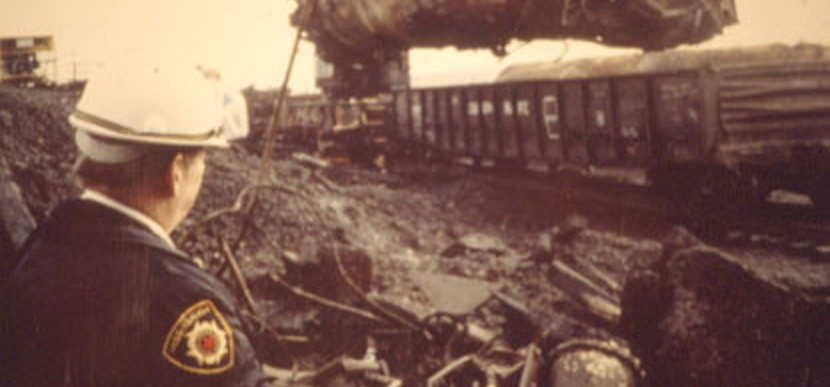
A police officer surveys the wreckage during cleanup. The mangled remains of a tanker car loom overhead.Mississauga Library System · Heritage Mississauga
The cost
The evacuation costs approximately C$22.5 million. Business disruption runs at roughly $25 million per day during the six days the city is closed. A $50 million class-action lawsuit is filed by 735 households and 128 businesses against CP Rail. Three greenhouses and a recreational building are destroyed.
Eight firefighters are hospitalised on 14 November for chlorine inhalation after encountering a pocket of gas. Some suffer lasting respiratory damage. Police Staff Inspector Barry King, who set up the command centre upwind of the chlorine, will feel the effects for the rest of his life.
"I went down with one firefighter near the train, and this puff of chlorine gas waved over toward us. He got a real dose of it and down he went. I don't believe he ever went back to work. I had a tenth of what he had, but it was just enough to sear me. I was coughing up green phlegm the whole week. Doctors told me I would start feeling the effects of the chlorine when I got older. I started feeling it around 51."
— Police Staff Inspector Barry King
Chemical runoff and firefighting foam contaminate Cooksville Creek and the Credit River. Heavy scorching and soil contamination require remediation at the derailment site. A follow-up public health study conducted two and a half years after the disaster finds that residents classified as "highly or moderately exposed" to the chemical plume report significantly higher rates of psychological distress, depressive episodes, and symptoms consistent with post-traumatic stress disorder. Zero deaths — but the Mississauga Miracle is not without lasting cost.
Hurricane Hazel
The derailment makes Hazel McCallion. One year into her first term as mayor, she goes three days without sleep coordinating the response. She sprains her ankle helping evacuees at a reception centre; OPP Deputy Commissioner Jim Erskine physically carries her into press conferences. She declares Mississauga "closed for business" and manages the crisis with a decisiveness that becomes legend.
The crisis cements her reputation as a hands-on, no-nonsense leader. She will go on to serve as mayor of Mississauga for 36 years — from 1978 to 2014, winning 12 consecutive terms — becoming one of the most recognised municipal politicians in Canadian history. She dies on 29 January 2023, at the age of 101.
"I don't know of any other thing that has happened in my 36 years as mayor that was as serious and as demanding and as stressful as the Mississauga derailment."
— Hazel McCallion, 40th anniversary, 2019
The lawsuit — and the train line
The city initiates a massive lawsuit against CP Rail to recoup emergency costs. But McCallion resolves it through pragmatic negotiation: she drops the lawsuit in exchange for CP Rail abandoning its long-standing opposition to allowing GO Transit to operate commuter trains on CP's Milton line. The GO Transit Milton line opens two years later — a massive infrastructural and economic boon for the rapidly growing city. Hurricane Hazel turns a disaster into a commuter rail service.
Larry Krupa
The brakeman who ran toward the fire continues working for CP Rail for 32 years, eventually becoming an engineer himself. He is inducted into the North American Railway Hall of Fame in 2012. He is invited to make safety recommendations that help improve industry standards — the worker on the ground, shaping the rules from the inside.
The long shadow
The Mississauga evacuation becomes a cornerstone case study in global emergency management — the gold standard for large-scale phased evacuations, inter-agency incident command, and managing public psychology during chemical threats.
Thirty-four years later, in 2013, the Lac-Mégantic rail disaster in Quebec demonstrates what happens when the margins are absent. An unattended freight train carrying crude oil rolls downhill, derails in the centre of a town, and explodes. Forty-seven people die. Emergency management analysts frequently contrast the two events: Mississauga benefited from fortunate topography, a thermal updraft, and rapid unified leadership. Lac-Mégantic proves that while technical regulations have improved, the base danger of hazardous rail transport persists.
The derailment leaves a mark on Canadian culture. Toronto rock duo Death From Above 1979 — whose name is a coincidence of drummer Sebastien Grainger's birth year, not a direct reference to the disaster — chronicle the event in their 2014 track "Trainwreck 1979." The bridge goes straight to the heart of the story:
"It ran off the track, eleven seventy-nine / While the immigrants slept, there wasn't much time / The mayor came callin' and got 'em out of bed / They packed up their families and headed up wind / A poison cloud, a flamin' sky / Two hundred thousand people and no one died / And all before the pocket dial"
— Death From Above 1979, "Trainwreck 1979" (The Physical World, 2014)
In Mississauga itself, the derailment is not remembered as a tragedy but celebrated as the Mississauga Miracle — a unifying foundational event for a city that had only been incorporated five years earlier. The shared trauma and safe return fostered a deep sense of civic identity among a sprawling suburban population that, until that night, had little in common beyond a postcode.
09 · Sources
Where This Comes From
All major claims in this article are sourced. Where sources conflict — particularly on evacuation numbers and chlorine quantities — the discrepancy is noted in the text.
OfficialReport of the Mississauga Railway Accident Inquiry (Grange Report), Justice Samuel Grange, Commissioner. Government of Canada, December 1980. 127 days of evidence, 687 exhibits, 23,594 pages of transcript, 15 recommendations.
OfficialCDC/NIOSH — Chlorine IDLH Documentation (immediately dangerous to life or health concentration values)
OfficialHeritage Mississauga — Tested by Fire: Remembering the Mississauga Train Derailment (brochure, undated). Images courtesy of City of Mississauga, Mississauga Library System, and Toronto Sun.
OfficialU.S. Department of Transportation — Major Railroad Accidents Involving Hazardous Materials Release: Composite Summaries 1969–1978, Report FRA-RRS-80-04, July 1980.
Hero and fireball from road: Pop History Dig (uncredited archival).
Aerial site overview and aerial firefighting: Report of the Mississauga Railway Accident Inquiry, Government of Canada, Crown Copyright 1980.
Silhouettes against fire: Toronto Sun, via Heritage Mississauga Tested by Fire.
Street-level fires: Pop History Dig (uncredited archival).
Chlorine tanker hole: Toronto Star, via Pop History Dig.
Gas mask traffic cop: Toronto Star, via Pop History Dig.
Deserted highway: Pop History Dig (uncredited archival).
Police command centre: Mississauga Library System, via Heritage Mississauga.
Colour aftermath aerial: City of Mississauga, via Heritage Mississauga.
Officer surveying cleanup: Mississauga Library System, via Heritage Mississauga.